Showing posts with label Collected Editions. Show all posts

Wednesday, 11 November 2020

Review: Supergirl Vol. 3: Infectious trade paperback (DC Comics)

DC Comics' latest Supergirl title struggled in its end. If that wasn’t apparent from its ignominious conclusion that saw the final two issues go digital-only, it certainly becomes apparent reading Supergirl Vol. 3: Infectious itself. And I would even actually say this book fares better than expected; though simplistic and repetitive, it doesn’t actually besmirch Kara Zor-El as much as other troubled stories have before. As well, if you like this sort of thing, Infectious runs the gamut of DC Comics events over the past year, from Event Leviathan all the way through the various incarnations of “Year of the Villain.”

None of that is enough to save what most seasoned readers will find an unimpressive comic — lack of suspense, sparse art, a string of action sequences over a number of issues as stand-in for any kind of plot development. The answer to why DC can’t get Supergirl right can’t be found here — this rushed book is a consequence of that trouble, not the cause of the trouble itself.

[Review contains spoilers]

Infectious has two main writers, Marc Andreyko and Jody Houser, with Robert Venditti stepping in for an annual in the middle. Of these, mainly as relates to my own interests, Andryeko’s is the better; I thought Andreyko’s last two “Supergirl in space” volumes in parallel to Brian Michael Bendis' Superman were a good use for this title, and I’m interested here to see Supergirl set within the events of Event Leviathan. My complaint, likely not Andreyko’s fault, is that he gets to finish little of what he starts — Kara’s adopted Earth-parents are tied up in Leviathan, but she never learns the truth, and also there’s a conflict with Brainiac that meets a speedy end when the book runs smack into Year of the Villain: The Infected.

To be fair, Houser is handed a real lump of coal here, a story where Supergirl is “infected” by the evil of the Batman Who Laughs and “goes bad.” We’re then subjected to four issues of an “extreme”-looking Supergirl fighting first Superman and Batman and then Wonder Woman, all of whom try to convince Supergirl that she’s not herself while she snarls and makes specious arguments about how she knows what she’s doing and she’s trying to save everyone, so on and so forth.

Obviously the audience knows the Supergirl Who Laughs is out of her own mind and obviously the audience knows she’ll eventually be cured and no harm will come to the other heroes; Houser is never able to make the transformed Supergirl palatable nor evoke any real drama in the story. Houser has Supergirl knock Wonder Woman about (and some government robots) for the better part of three issues, and there’s nothing here that couldn’t have been accomplished in just one issue. Wonder Woman employs no strategies nor changes her approach other than to try to beat Supergirl into submission while Krypto whines on the sidelines.

Artist Rachel Stott’s work is particularly rough in these issues, though one wonders exactly how much time was allotted for these in the switch from Andreyko to Houser and the cancellation. By and large the panels lack backgrounds, except for one lone farmhouse meant to typify Smallville and what eventually looks like a desert-scape. Toward the end of these issues, Stott employs just a generic arrangement of four or five horizontal panels for each page; anatomy is also distorted at times, with too long arms or legs.

The final two issues, originally released digitally, jump forward in time, so that from the cliffhanger of issue #40 to issues #41 and #42, we never actually see Supergirl escape the titular infection. Maybe here there’s a directive to Year of the Villain: The Infected that was not included in the trade, but this seems another bit of sloppiness, a way the book just doesn’t read well. Those last two issues see Supergirl rescuing people from a hurricane while hallucinating images of old enemies; that’s well and good (though no more consequential), though an editor lets through the Cyborg Superman-as-Supergirl’s-father, which is no longer actually the case.

In the center of this is Robert Venditti’s Supergirl annual, “The Best Day of Her Life.” This is an interesting one, as it has elements of “Infected” — the Batman Who Laughs appears, Kara has nightmarish hallucinations about the destruction of Krypton — but it’s mostly the telling of a perfectly normal day on Krypton where Kara is supposed to babysit her infant cousin Karl and has her boyfriend sneak over. I know Venditti mainly from Green Lantern — a writer not overly bombastic, but also not one whom I’ve seen do a slice of life story like this before. Though I don’t particularly think Venditti’s would be the right approach for an ongoing Supergirl book either, as both Andreyko and Houser navigate their various events, Venditti’s annual is a nice change of pace in the middle.

Something draws DC to present these Supergirl-gone-bad stories over and over — the original Superman/Batman debut of this Kara Zor-El who had some sort of dark twin, the later Joe Kelly bad girl iteration, Kara’s stint as a Red Lantern, and I’m probably forgetting some. It is not then perhaps Jody Houser’s fault that the latter half Supergirl Vol. 3: Infectious feels like a lot else we’ve read, but then again neither do Houser and Rachel Stott manage to make anything out of what they’ve been given.

Support Collected Editions -- Purchase Supergirl Vol. 3: Infectious

3

Rating

DC hasn’t seemed to know what to do with Supergirl for a while; though the Rebirth iteration originally hewed to the Supergirl TV show, that faded, and the book meandered a bit until Andreyko took over, but there just in the service of the Superman books. With the CW’s Supergirl ending after this coming season, it seems an opportunity for DC to let this title lie fallow for a bit and then resurrect it with no external pressures. Whether something readable can be built from that remains to be seen.

[Includes original and variant covers, character designs, script-to-color progression]

Sunday, 8 November 2020

Review: Batman: 80 Years of the Bat Family trade paperback (DC Comics)

There’s been a lot packed in to the recent Action Comics and Detective Comics issue #1000 specials, with perhaps enough pressure to deliver stories worthy of the monumental issues that at times they seemed too highfalutin, too grandiose. For Batman: 80 Years of the Bat Family, maybe it’s the occasion of the collected format, or maybe that the Robin, Catwoman, and Joker issues are “80th Anniversary 100-Page Super Spectaculars” rather than the #1000s, but I found the stories uniformly approachable and enjoyable.

There’s a fine mix here of creators historically or currently involved with these characters, one-off stories and stories revisiting specific instances of these characters' eras, and even stories set during current events in the characters' titles. All of that makes these specials feel wholly worthwhile, true anniversary parties and not just more skippable anthologies on the stands. I’m hopeful these serve as models for other such specials going forward.

[Review contains spoilers]

The Robin special is weighted toward Dick Grayson, not undeservedly since it’s his 80th anniversary after all. But right off these specials show a good strategy; of four Dick Grayson stories, we skip perhaps a cutesy, traditional “young Robin” story, going instead for recognizable, popular Dick Grayson eras. Among the most welcome of these is a Nightwing story by the legendary Chuck Dixon/Scott McDaniel team, set around Batman: Cataclysm in the heart of their run. Devin Grayson tells a Titans story set in her era (with art by friend of the Titans Dan Jurgens), and Tom King, Tim Seeley, and Mikel Janin re-team for a Grayson story. That’s all of what I want from a Robin anniversary book (plus Marv Wolfman and Tom Grummett on a story roundabouts New Teen Titans) and the book’s only just getting started.

Further winks and nods abound — Jason Todd by Judd Winick, Tim Drake by Adam Beechen and Freddie Williams, James Tynion writing a prelude to his Detective Comics run, and Damion Scott draws Stephanie Brown as Robin again, with Amy Wolfram writing. I have mixed feelings about that one: I’m glad to see Stephanie-Robin included but I’m sorry to see the story still depict Stephanie as a screwup; I find the premise that Batman doesn’t know how to costume for a girl clever but I wish the lone “in-continuity(ish)” female Robin story wasn’t about sartorial choices and didn’t include the word “booty.”

Rounding it out, I was pleased to see, was a Damian Wayne story by Teen Titans writer Robbie Thompson, set within that book’s current events and after Batman: City of Bane. That’s a facet of all of the specials — the Catwoman book has one kicking off Ram V’s run on the title, and the Joker book has a Punchline origin by Tynion. Possibly 80 Years of the Bat Family would have gone to the bottom of my pile if it were just one-off stories, but the fact that these specials got the characters' actual writers in here for relevant stories goes a long way for me.

That Joker book is at times downright terrifying, which is apropos for a Joker book though I was surprised by the extent. The book struggles a bit around a weaker tale by Dennis O’Neil with some repetitious dialogue (though art by Jose Luis Garcia-Lopez), but picks up frighteningly in stories by Tom Taylor and Eduardo Risso, Rafael Albuquerque, and others. Peter Tomasi’s got an uncharacteristically weird one with art by Simone Bianchi. Tynion’s Punchline story didn’t enamor me of the character any more, but again I’m glad it was there.

The Catwoman book also has a lot of fine guest stars — King and Janin, perhaps in prelude to King’s Batman/Catwoman; Ann Nocenti; Mindy Newell, in a story surprisingly frank about Selina Kyle as a prostitute, something DC sometimes tries to gloss over; Dixon and Kelley Jones, drawn in the Jim Balent costume; Will Pfeifer, with art by Y, the Last Man’s Pia Guerra; Ram V and Fernando Blanco; and finally Ed Brubaker. That one’s got the classic team of Selina, Holly Robinson, and Slam Bradley in it, leading one to wonder sometimes why good things can’t just stick around forever.

Kicking off the book is a reprint of Detective Comics #1000, which might be a little bit of a cheat, though this book is otherwise packed enough that this doesn’t feel like blatant double-dipping. There’s two new stories in there, too, however (previously appearing in various Detective #1000 reprints). The one by Robert Venditti, featuring Two-Face, didn’t move me quite so much, but the second — Alan Grant writing Anarky, the Ventriloquist, and Batman with a yellow chest circle, drawn by McDaniel — is a real blast from the past treat. I wish “the shadow of the Bat falls on …” could’ve been worked in there somewhere.

Support Collected Editions -- Purchase Batman: 80 Years of the Bat Family

4.5

Rating

So again, I liked Batman: 80 Years of the Bat Family and I’d be happy to see something like this come around again. If I’m not missing anything, there’s only one more of these out there, the Green Lantern 80th Anniversary 100-Page Spectacular, which is a shame — not the book itself, which I’m eager to read and I might just have to pick up on its own, but that there’s not some other Justice League compatriots with which DC could make another one of these collections. A nice “bridge” to a couple different storylines going on in the Bat-titles.

[Includes original covers, pin-ups]

Wednesday, 4 November 2020

Review: Batman Vol. 1: Their Dark Designs hardcover/paperback (DC Comics)

Among James Tynion’s mandates for his new Batman run starting with Batman Vol. 1: Their Dark Designs, I imagine chief among them was not to be Tom King. Hey, I liked King’s run very much (if fair is fair, in the final tally it’ll be recognized as something more than just superhero comics, approaching real art), but I recognize it was not the most accessible to the reader off the street, and that’s where DC’s got to cater. That’s by no means to denigrate Their Dark Designs, which is in its own way smart and multi-layered and has things to say about where Batman goes now in this strange new decade. But as was the case when King was on Batman and Tynion was on Detective, Tynion’s title is the more normative comics experience, a straightforward Batman romp without an instance of a character repeating only the same words of dialogue throughout an entire issue.

That’s ultimately good for Batman, which after a couple years of upheaval is due now for a calmer assessment of the new status quo. To Tynion’s credit (not that we expected anything less), Their Dark Designs is a respectful bridge, utilizing naturally what came before as it charts what comes next.

[Review contains spoilers]

Their Dark Designs is many stories at once — a rare spotlight on Batman’s most classic, most recognizable foes; a venue for Tynion to throw a lot of new characters at the wall and see what sticks; and in the end, prologue to Tynion’s inaugural big “Joker War” event. The structure truly is compelling, because for what turns out to be a big trick story, Tynion really commits: an entire issue dedicated in flashback to the villain Designer’s meeting with the Joker, Penguin, Riddler, and Catwoman, plus young Bruce Wayne’s encounter with the Sherlock Holmes who’s been hunting Designer-as-Moriarty. When it turns out all of this was a ruse by the Joker, it’s hard to believe that’s the last we’ll hear of the Designer mythology.

Between the Designer, the Underbroker, and the Joker’s new sidekick Punchline, Tynion demonstrates his knack for creating new villains that we also saw in his Detective Comics (I wouldn’t mind at all his bringing over the First Victim or others from that title to here). In both Designer and Underbroker, we see whole cloth not only costume and villainy, but also things like secret identities, day jobs, and individual foes aside from Batman. Tynion too breathes new life into old classics the Penguin and the Riddler; with Catwoman now a semi-permanent fixture and ally, Tynion seems to blur the line of friend and foe for Batman, Penguin, and Riddler as well, an enemy-of-my-enemy-is-my-friend kind of deal. To an extent, the “team” in this book (after Tynion’s Gotham Knights in Detective and his Justice League Dark) is Batman and his foes, similar to the latter days of A. J. Lieberman's Gotham Knights title, and I wonder if that’ll continue after “Joker War.”

I was less enamored with Tynion’s creation Punchline, though it was not clear to me how much I was supposed to be. There’s been much aftermarket uproar about her various first appearances, I understand, but I’m not sure how much of that is love for the character and how much is gambling on Punchline, aligned with the Joker, becoming a popular “next Harley Quinn.”

Maybe some of that would have been more apparent had Harley herself not been here (cementing her “new classic” place among three other Super Friends villains), but having the two battling in the seventh chapter, Harley comes off in every way the superior character — funnier, more nuanced, sounding less like a stereotypical 1990s cool-bad villain, not to mention that we already know how the Ambush Bug-esque Harley is equally comfortable both here and in a wild time travel romp, a similar promise that Punchline does show. Perhaps it’s simply not a competition, that Punchline functions perfectly well as “just” a Bat-villain while Harley can go off and have her adventures across the DCU, but pitting them against one another it seems like the audience is meant to choose and that the choice is obvious.

Alfred Pennyworth died in only the last storyline, perhaps the biggest seismic change in the Bat-titles in decades (if we thought it was ever going to stick). I might’ve liked to see that play out more but I don’t think Tynion had the time (maybe we’ll see that in Peter Tomasi’s Detective). Instead, we swiftly have Lucius Fox in Alfred’s role, making Alfred seem somewhat replaceable and without Batman seeming to learn to stand on his own without Alfred. All of that is regrettable, though I do give Tynion credit for a bunch of cool new Bat-toys with Lucius in the support role — the Nightclimber, the Bat-shot, the Echo, the Batspawn, and so on.

In this — Batman’s tech taking a leap forward, plus the underlying storyline of Bruce Wayne rebuilding Gotham — Tynion’s debut reminds of his predecessor Scott Snyder’s at the start of the New 52. In fact, one might opine a throughway from the New 52, where Bruce’s Gotham redesign was waylaid by the Court of Owls, through attacks by the Joker and Bane to the present, where everything’s calmed down enough for Bruce to try again. “Calm” is of course a relative term with the Joker having stolen all of Bruce Wayne’s money, but still, we start to see something now — a self-sufficient Batman without Alfred, a Gotham designed by Batman, a Batman “married” to Catwoman, a Batman allied with both the heroes and villains of Gotham.

All of these point the way to something actually new, different than the status quo, for however long that might last. There’s a theme in this book of an “exponential leap in the design,” the idea that Batman, his enemies, even Gotham City is only triumphant when it goes two steps forward, past the expected point of evolution — when a Year One Bruce Wayne suddenly became Batman, for instance, or this moment of the Joker stealing all of Bruce’s money. We’ll have to see how it all plays out, but arguably Tynion is trying to do the same — to jump the Batman title farther, to raise the stakes, to see in some regard the fruition of what Tom King started, an exponential leap in Bat-storytelling that makes a break with the old.

Support Collected Editions -- Purchase Batman Vol. 1: Their Dark Designs

4.5

Rating

Indeed I have no great qualms about Batman Vol. 1: Their Dark Designs and much excitement for James Tynion’s Batman run; I wouldn’t mind another 80 issues like Tom King did. If anything, I think the artists show their newness to the project, though neither are new; Tony Daniel has some improbably shaped figures in the first issue, with the characters' eyes staring past one another, and Guillem March poses Catwoman and Harley Quinn, especially, in ways that have nothing to do with the dialogue on the page. Later in the book, artists Jorge Jimenez, Javier Fernandez, and Rafael Albuquerque do well, and overall all of the artists are similar enough to give the book a consistent feel.

[Includes original and variant covers, Secret Files issue]

Sunday, 1 November 2020

Review: Flash Forward trade paperback (DC Comics)

Flash Forward

Writer Scott Lobdell has no easy job in Flash Forward taking recently-turned-toxic character Flash Wally West and trying to make a miniseries out of him. Lobdell doesn’t even get the benefit of the years that DC let Hal Jordan lie fallow after his fall from grace, nor even the excuse of cosmic manipulation. No, in what is instead a rather vulgar exercise in storytelling, DC goes straight from crime to redemption tour, and the losers here are the poor characters already in limbo who’ve served as so much fodder for the whole endeavor.

None of that is Lobdell’s fault, and Lobdell and artist Brett Booth do exceptionally well here taking Wally from one of DC’s darkest moments and spinning out something that’s exciting, emotional, and most of all fun. It feels altogether too soon for “fun” with Wally and it’s hard not to see some of this as a tad grotesque; at the same time, Lobdell seems to get to the core of the character — reaffirms it, perhaps — and the book’s most redemptive moment is sweet enough to make a lot of this worthwhile.

[Review contains spoilers]

From the cell blocks of Blackgate prison to the wild far reaches of the Multiverse, Lobdell makes this feel like a classic Wally West story. We start with a couple of Geoff Johns' Wally West villains — a dose of the new-classic — and move swiftly into a tour of Grant Morrison’s Multiversity multiverses. Wally as a nice guy out of his (reality) element is an old standard — be it a mirror-verse, the future, or what have you — and by the second issue, this all feels nicely familiar. Though occasionally reminded of the half-dozen-plus people he killed in Heroes in Crisis, Wally is swiftly in better form than we’ve seen him in a while, cracking jokes, making friends, and hurriedly saving the day even when potential Multiversal allies see him as a threat.

I’ve been disappointed at times to see DC titles venture out into the so-called Multiverse (Terrifics comes to mind) but not use Morrison’s Multiversity, so well crafted it was and used at other times. Lobdell’s Flash Forward, as it turns out, is soaked in Multiversity, and employing a Convergence or Secret Wars-type formula where the different Earths are set against one another with Wally in the middle. Highlights include President Superman’s Earth-23, Earth-8 of the marvelous Retaliators and Zen-Men, the Earth-43 of Batman: Red Rain, the super(hero)natural Earth-13, and the amalgamated Earth-32. Even what little dialogue these alt-heroes get is more, and more detailed, than the recent same in Justice League Vol. 5: Justice/Doom War, for instance; that we actually get some rhymes from Superdemon Etrigan shouldn’t be the miracle that it is.

That’s most of the book, drawn with exuberance (but restraint) by Booth, until Wally lands on a planet created by his own fear, which contains his lost children but which must be destroyed to save the rest of the Multiverse. For a dark moment it does seem as though Wally will have to lose his children a second time for the good of creation, which would have been an awfully dark resolution to this book; instead, Lobdell swings wildly the other way, in which Wally is riding the Mobius Chair off to Dark Nights: Death Metal and his children are dropped back down on Earth at the doorstep of their mother, Linda Park, who suddenly remembers them. Even as I’ve never been a big fan of the extended West family as a plot device, that moment’s pretty great, and moreover that Linda’s “back.” Even if we did not see that Wally is essentially himself now (just Dr. Manhattan-powered), fans of Mark Waid’s and Johns' runs know the fact that Linda’s on the case pretty much assures Wally will be returned to his old self one of these days.

It’s inescapable that Wally accidentally killed a bunch of other heroes; again, I don’t think DC can cry Parallax on this one lest it cut Heroes in Crisis off at the knees. With all of Wally’s super-powers now, obviously a good solution would be for a writer to have him to restore those heroes back to life (Lagoon Boy will thank you), but I’m not sure that can quite surmount some awkward Titans reunions (I’d like to have seen, but I don’t think we have seen, Nightwing have visited Wally in prison during this time). But when Wally thanks his mystic guide Tempus Fuginaut “for giving me the strength to remember the man I was before,” it’s a tad icky — too soon, given the character tried to get away with murder not much more than a year ago. Then again, it’s not as though it’s a flaw in the character, either — as I’ve said before, it was always bound to get messy ever since DC brought back a hero with a wife and kids and held him out as a symbol of hope despite no clear story plan to reunite him with his family other than making him sad for a long time.

Support Collected Editions -- Purchase Flash Forward

4.25

Rating

Again, jolly good to Scott Lobdell for pulling a win out of that. Flash Forward was a hard one to do, but not only does Lobdell do it, he does it in such a way as to indeed remind the reader what we like about Wally West — writing Wally the best, perhaps, since Wally’s heyday. And again, Brett Booth is very strong here, with very dynamic art but none of the brain-bending paneling that’s been bothersome before (he also apes Dan Jurgens and others well in the time-spanning epilogue). Lobdell and Booth for a new Flash team? Maybe. Bottom line, DC’s got three books on the stands right now that lead in to Dark Nights: Death Metal, all with their share of challenges: Justice League Vol. 5: Justice/Doom War, Year of the Villain: Hell Arisen, and Flash Forward; of these, Flash Forward is the best.

[Includes original and variant covers]

Wednesday, 28 October 2020

Review: Year of the Villain: Hell Arisen trade paperback (DC Comics)

Year of the Villain: Hell Arisen is ostensibly the culmination of James Tynion’s Justice League series-within-a-series, “Legion of Doom,” though that doesn’t really come through till the book’s halfway point. When it does, what’s here gets sharper, but overall the book struggles to overcome its biggest disadvantage — that, like the Justice League Vol. 5: Justice/Doom War that leads in to it, Hell Arisen is a book where not much of import happens and that’s basically just an advertisement for another book that follows it (which leads into something else after that).

As well, though I’ve enjoyed artists Steve Epting and Javier Fernandez on a variety of other books, all the art here is too soft, too inexact, lessening the dose of urgency and seriousness this book desperately needs. We know James Tynion, we know his books, and we know the competence of his writing (which again, I think comes out more in the book’s second half). For a book with a variety of challenges, perhaps an artist with more straightforward drama — a Detective Comics collaborator like Miguel Mendonca or Eddy Barrows — could have benefitted this overall.

[Review contains spoilers]

That the first two chapters of Hell Arisen are its least interesting, and that those two chapters deal with the Year of the Villain “Infected” storyline, is not a coincidence. DC’s choices for the Infected heroes seemed questionable from the outset — characters with endangered or nonexistent series, safe or rife for profile but also with low emotional stakes. They were universally written as over-dark if not whiny, and that continues here — a gone-bad Shazam calling Lex Luthor “baldy” does not a compelling conflict make. And that is indeed half of the first issue and all of the second; to read just half of this book in one sitting (as I did), one wouldn’t be faulted for considering Hell Arisen a miss.

But it is a truism because it’s often true that there’s little that can’t be fixed by a Joker appearance. At the head of the third chapter, Lex calls in the Joker to rescue him from the Infected; the Joker previously abandoned Lex’s Legion of Doom in Tynion’s pages of Justice League. As such, we have something of a reckoning here — a thematic throughway when so much of the “Justice/Doom” storyline has lacked such. And, there’s an impressive standoff when the Joker holds a gun to Lex’s head, and a psychedelic sequence when Lex convinces the Joker to let him do telepathic brain surgery on him. In all of this, Tynion captures the spirit of good modern Lex/Joker team-ups, like Underworld Unleashed or Dave Gibbons' World’s Finest, two villains not so dissimilar as they might originally seem. An added boon: Tynion is working within the threads of his new Batman run, too, giving new character Punchline an early cameo.

A few good elements follow after that. One, that Lex also gets some help from a handful of the villains he powered up during Year of the Villain. Not many of those appear, nor do they interact with Lex in any meaningful way, but still, the events of the past year are at least passingly acknowledged in Hell Arisen, whereas they’re hardly much a topic of Justice/Doom War. Second, both the third and fourth chapters see a role played by ubiquitous Lex sidekick Mercy Graves, who if not her usual take-charge self here at least offers some perspective on the discrepancy between Lex Luthor, foe of metahumans, and Lex Luthor, transformed into a hybrid Martian by cosmic goddess Perpetua.

The latter includes the crowning sequence of Hell Arisen, in which Tynion traces and unifies Lex Luthor’s history from the New 52 all the way to the present. This spans two continuities, yes, two different Supermans, etc., but Tynion elides it to make something consistent and sensible, putting even Lex’s role in Forever Evil into perspective toward ending up at Lex’s current form and goals. That’s fantastic, a culmination of “Year of the Villain” that does indeed feel like a culmination — and which makes me eager to see what happens to Lex after all of this is over and hopeful that Tynion has a hand in it. In this, we do indeed see some reason for Hell Arisen, some purpose for this miniseries that maybe couldn’t otherwise be presented in Justice League proper.

And that’s important, because without at least those Lex Luthor character moments, Hell Arisen might seem skip-able. Over four issues, the only event of any note comes in the very final pages, in which the Batman Who Laughs switches sides to work with Perpetua, replacing Lex. This is nearly nothing — the Batman Who Laughs miniseries was enjoyable, but there’s nothing really to have kept him from working with Perpetua at the same time, nor did the dark Batman’s Infected ever make a dent. Essentially, all of Hell Arisen was to make one tiny change ahead of Dark Nights: Death Metal that could have as easily always been the case; much like Justice/Doom War, Hell Arisen might otherwise seem like an attempt to wring more cash out of those anticipating Death Metal, not a miniseries with real value in and of itself.

Obviously times are tough, and even tougher in the midst of DC corporate shakeups alongside global events. But there’s a bunch too that doesn’t line up between Justice/Doom War and Hell Arisen that gives the sense of only so much care given — the Phantom Stranger is free at the end of Justice/Doom but the Batman Who Laugh’s prisoner in Hell Arisen; the Infected are and are not infected in Justice/Doom, but then are infected and then cured in Hell Arisen, taking place afterward; the Earth is supposedly wrecked at the end of Justice/Doom, ahead of the Justice League’s departure, but the Hall of Justice is shown more normally (even giving tours) in Hell Arisen, despite acknowledgment that the League is gone. As dual lead-ins to Death Metal, Justice/Doom and Hell Arisen ought be seamless, and the fact that they’re not only magnifies their other problems.

Support Collected Editions -- Purchase Year of the Villain: Hell Arisen

3.75

Rating

Again, Year of the Villain: Hell Arisen is misguided in a variety of ways, including that at least in the first half, neither art nor conflict seems to try to make for a compelling comic. If you’ve come this far though, in the end, where “Year of the Villain” seems to be treading water as it waits for Dark Nights: Death Metal, there is at least a little payoff and some bright spots to be found. And, the Year of the Villain special is in here, what should have originally been slotted in a Justice League volume or two ago; better late than never.

[Includes original and variant covers, character sketch]

Sunday, 25 October 2020

Review: Justice League Vol. 5: Justice/Doom War trade paperback (DC Comics)

Justice League Volume 5 Justice/Doom War

Though the final issue collected in Scott Snyder’s Justice League Vol. 5: Justice/Doom War was released in at the beginning of this year (and the collection in June), it couldn’t feel more relevant than right here, right now. The war that Snyder’s League fights in these pages is ultimately one of ideologies — “… The rise of evil in this universe. The lack of connection between the good.” When the League makes their final case to the people of the world to turn away from the cosmic evil Perpetua, it comes down to a consensus choice. Then the world goes dark. “What happened?” Wonder Woman asks. Batman pauses a moment and replies, “We lost the vote.”

Whatever side of that metaphor you fall on, it is Justice/Doom War’s saving grace that it has a metaphor at all. Snyder’s last Justice League volume is big on summer blockbuster theatrics and cool moments, but small on plot, real character development, or anything to conclusively tie up this Justice League era proper. That you can find some connection to the here and now gives Justice/Doom War that little nugget of interest that it desperately needs; otherwise this volume is like so much momentary cotton candy, a letdown after a good run overall.

[Review contains spoilers]

What turns out at the end of Justice/Doom War was that this entire saga was an exercise by Perpetua to bring the League to a place where they were utterly let down by humanity — that Perpetua foresaw that the League would try to rally the people of Earth to their cause and be rebuffed. That itself was an eventuality planned for by the Quintessence (Ganthet, Highfather, the Wizard Shazam, and such), who absented themselves long enough to save the League from Perpetua and then send them back after her again … in the pages of Dark Nights: Death Metal. So it is that the League was fighting a battle — has been fighting a battle all this time — that they were not going to win, were never even supposed to win, and the real story is all to be found in another title entirely.

This is not at this point a surprise, as news of how League ended spread rapidly, nor unfortunately is it even unprecedented (Justice League: Trinity War begetting Forever Evil and even Death Metal itself now leading in to “Future State”). But I’m put in mind of Grant Morrison’s JLA: World War III, a multi-part conclusion housed entirely within Morrison’s JLA, or even the far end of that book, JLA: World Without a Justice League, which itself admittedly lead in to Infinite Crisis but did not have the same “none of this actually mattered” twist as Justice/Doom War does. Way back when, the Superman Triangle Titles killed off Lex Luthor in one single issue (he got better. It was a whole clone thing). Nowadays it feels at times that good stories have given way to squeezing every last cent out of the reader as long as possible.

It’s a shame, because one really wants to enjoy Snyder’s cut-loose roller coaster thrill ride. I can hardly fault a title precipitated on a dust-up between the good Justice League forces and the bad Legion of Doom for wearing its heart on its sleeve, and Snyder’s War has heroic heart in spades. “We can do this,” an awfully optimistic Mera reassures Hawkgirl Kendra Saunders. Wonder Woman counsels a down-and-out Kamandi that humanity is more than war: “There is also passion, and hope … and truth.” Green Lantern John Stewart turns Vandal Savage’s heart by explaining that there’s “just one fight” that we all have to fight together, an all-pain-is-the-same message applicable to mental health and etc. that I’ve been glad to see from DC lately in Snyder’s work and Tom King’s Heroes in Crisis, among others.

As well, Justice/Doom War has cameos and crowd scenes galore, something we lost when the New 52 made everyone a stranger but that I’ve been glad to see make a comeback. Most of DC’s current lineup is here, plus the Justice Society to start, and then DC One Million’s Justice Legion Alpha, Batman Beyond and his Justice League Beyond, and then scores of Multiversal others. Snyder’s got the gang back together as best he can and that makes for plenty of stand-up-and-cheer moments.

But even this lacks for something when you dig beneath the surface. Sure the Justice Society is here, and Green Lantern John Stewart and Flash Barry Allen think to themselves it’s strange they never heard of the Society before, but it doesn’t go farther than that — Snyder is holding out their real return (versus this return-light) for his event series. Nor does Barry offer any acknowledgment that Jay Garrick is the selfsame Flash that Barry met and was very concerned about in Batman/Flash: The Button. Nor is any connection shown between the Batman Beyond here and the one who appears in Dan Jurgens' series, a big missed opportunity (might as well have made that title part of “Year of the Villain” and bumped sales). 

Point being that yes, the gathered Justice Leagues of the Multiverse are here, but they’re just figures on the page that you could give or take, not really anything all that relevant to the story. As I’ve said before, the characters of the Multiverse are often the go-to for DC writers in need of applause lines. Applaud I did, but there’s nothing particularly relevant or earth-shaking here to convince me a reader couldn’t just jump from Dark Nights: Metal to Dark Nights: Death Metal and skip this Justice League title entirely.

I must say, too, poor Hawkgirl. One-time JSA breakout star Kendra Saunders emerges here as reckless and foolhardy, basically handing victory to Perpetua (and getting Starman Will Payton killed) because she can’t control her emotions and stick to the plan. What’s got Kendra so out of sorts is the recent apparent death of the Martian Manhunter, with whom Kendra had only recently, and not wholly convincingly, started a relationship.

Snyder has done little to flesh Kendra out — reintroduced in Dark Nights: Metal, it seemed people kind of already knew her, but how she became Hawkgirl and what her recent history has been, Snyder’s never shown us. Instead, Kendra finishes out this title as unhinged mourner for a man she just met, and there is hardly even time for reunion with the resurrected Manhunter as the book ends. If there will be a final word on Hawkgirl and Martian Manhunter’s relationship, it’s not found in the very book it started in.

Support Collected Editions -- Purchase Justice League Vol. 5: Justice/Doom War

3.75

Rating

Again, Justice League Vol. 5: Justice/Doom War is a fine bubble gum story. The book is full of big ideas and big showdowns, and if I can project what Justice/Doom War might have going for it that Death Metal will not, it’s an Earth(ish)-bound story of the Justice League fighting their arch-enemies Challenge of the Super Friends-style, often in souped-up flying headquarters, without alternate realities and forgotten identities and such. It purports, at least, to be a classic-style Justice League story. I enjoy that, and I can appreciate that; I just wish it didn’t send me somewhere else to get the story that properly should have been right here.

[Includes original and variant covers]

Wednesday, 21 October 2020

Review: Deathstroke: RIP trade paperback (DC Comics)

Deathstroke RIP

With its 50th issue, Christopher Priest’s Deathstroke comes to a close, a book often the best of DC’s Rebirth line. In Deathstroke: RIP, the seventh volume of the series, Priest reiterates what he’s been saying all along: if you think Deathstroke’s a villain, you should see the other guy. There have been “other guys” throughout the series, but in this last book, Deathstroke fights himself, and he’s left to consider seeking redemption when faced with a glimpse of how bad things can get.

Priest is a writer who’d been out of the comics scene for a while, and his stellar work on Deathstroke immediately showed we’d been lesser for his absence. I don’t see Priest’s name on anything else coming up from DC with Deathstroke’s conclusion, not even a “Future State” special, which is all the more a shame. As complicated and as mature as Priest’s Deathstroke was, I can only hope for a DC Black Label reprise — surely someone should be writing a Black Label Deathstroke mini, if not Priest (it can’t all be Joker specials).

[Review contains spoilers]

RIP is ultimately the tale of “our” Deathstroke Slade Wilson, recently murdered and resurrected, versus what turns out to be a dark(er) Multiversal Slade. That’s fine, though as the alt-Slade stumbled around fussing about what Raven had done to him, I momentarily hoped this would be Rebirth Slade versus some sort of pre-Flashpoint Slade, crazed in the midst of fighting Geoff Johns' Titans or something.

Failing that, once we got the first intimations that alt-Slade was from the Dark Multiverse (of post-Dark Nights: Metal and Tales of the Dark Multiverse fame), I rather hoped Priest would lean into the (hardly used) Dark Multiverse concept, again making this alt-Slade a direct offshoot of a different choice made during Judas Contract or etc. This didn’t particularly hurt my enjoyment of the story, I just wish the alt-Slade hadn’t been so random, from an anonymous dark world where Damian Wayne and Wonder Woman are in Slade’s thrall. I did enjoy that alt-Slate’s world is indeed populated by a pseudo classic New Teen Titans, though they’re barely important to the story as a whole.

The actual point of RIP’s matchup is that our bad Slade, considering hanging up his sword, meets an even worse Slade — stares into the abyss, as it were. This is not the first time in this series Slade’s considered “going good”; indeed, one of the central tensions of Priest’s Deathstroke’s life is the work of his best friend Wintergreen to try to get him on a noble path even as Slade continually does bad (of sorts, because Priest’s Deathstroke’s assassinations often have a hint of benevolence to them). Trying to clean up his act is rather this Slade’s addiction, the thing he tries to do (with his short-lived Defiance team, for instance) before he eventually falls back into his old, bad ways.

This plays out in the book’s kicker, which in addition to being a rousing “here we go again” punchline is also wildly true to form for this book. Slade finally has what he’s sought this whole time — his family reunited over Thanksgiving dinner, his son present and his ex-wife and illegitimate daughter no longer trying to kill one another (momentarily). He has just even seen the flip side of this, an alt-Slade who rejected all of these family ties and basked in his darkness. And yet, and yet, no sooner does Slade sit himself down with all this normalness than he hears the call of the assassin’s life again and he’s out the door. Deathstroke may very well try to go good again, but writer Priest, at least, knows who Slade Wilson really is.

In terms of Priest’s Deathstroke, the series has been stranger, more impactful, and more out-and-out violently absurd than RIP. It’s enjoyable at any rate, and certainly shocking — supporting characters, for whom Priest has won our affection, do not fare well this time around, and I felt badly for both Hosun and Barry. But by virtue of the fact that our Slade is “dead” for most of this and that daughter Rose (Ravager) and son Joey (Jericho) both fight the alt-Slade alone, there are not so much of the “hugging one minute, punching the next” dynamics of the previous books.

Almost assuredly, as well, Priest does not tie up every remaining loose end, where Power Girl Tanya Spears disappeared to (hopefully Priest can return to the character someday), why it was Rose was possessed by a Hmong spirit, the upshot of the experiments by Dr. Arthur Villain (it’s pronounced “Will-hane”) and on. Even if that’s expecting too much, RIP is startlingly self-contained for this title (not a bad thing necessarily when the previous volumes came out a year ago with a year delay prior to that, too). Though good throughout, largely Priest’s Rebirth Deathstroke hummed along as one story for the first five volumes, with the last two “numbered” ones, plus Priest’s Batman/Deathstroke, being more one-offs (perhaps reflecting the omission of the volume numbers in the names for the Deathstroke series more than most).

Support Collected Editions -- Purchase Deathstroke: RIP

4.0

Rating

Still and all, it is no exaggeration to call Christopher Priest’s Deathstroke among the best of the Rebirth series, and as I’ve said before it most certainly deserves an all-in-one omnibus edition. Even more importantly, Priest’s Deathstroke is the best, most down-to-earth Deathstroke series we’ve seen from DC in a while, after a couple of significant missteps, and hopefully it’ll be the model DC follows whenever they try a Deathstroke series again. It’s sad to say good-bye to Christopher Priest with Deathstroke: RIP, but hopefully his absence won’t be as long this time.

[Includes original and variant cover, pencilled pages by Fernando Pasarin]

Sunday, 18 October 2020

DC Trade Solicitations for January 2021 - Joker War Saga, Harley Quinn and the Birds of Prey, Green Arrow: 80 Years, Batman: Gotham Knights Vol. 2, Wonder Comics Amethyst, Swamp Thing: New 52 Omnibus

It's the DC Comics January 2021 trade paperback and hardcover solicitations, though no doubt all eyes are on the two-month "Future State" event, following the one-month "Endless Winter" event. This is a not insignificant breather DC is taking here and I'm curious what things will look like on the other side.

Much as I thought there were a lot of positives to Dan DiDio's time at DC and I regret his ouster, it's astounding to me to think that he was about to revamp DC's line. I would say "especially since DC has hardly had a cogent timeline in years," which I would have liked to have seen before they cleared the decks again, but apparently the so-called "5G" would have delivered a timeline at the same time as its revamping (equally a novel and long overdue idea). Still I don't think a new timeline is the solution to what ails DC; rather I'd prefer to see them iron out the one they have, the unwritten playbook that most everyone seems to be going off of except the readers.

Publishing what they've got as "Future State" is a good solution, better than letting it all go to waste and leaving us to wonder for years what it was all about. But it's a two-fold shame, one that Doomsday Clock had to be bent to dovetail into 5G ('cause we sure know it wasn't headed there originally) only for 5G never to happen, and two that Dark Nights: Death Metal now leads in to Future State since simultaneously we're also given to understand Future State is a temporary measure and surely that wasn't the plan for Death Metal either. So not to be cynical but it all seems like more of the same old thing — every book's an advertisement for the next one and everything's important, even the one-off, two-month filler events.

That said, we're for some thick Future State collections, and I'm looking forward to them.

This month in collections, not a blockbuster, but some stable releases. Harley Quinn and the Birds of Prey: The Hunt for Harley is probably the one I'm most looking forward to, seeing Amanda Conner and Jimmy Palmiotti writing Harley again. I'm sorry to see Adam Glass' Teen Titans ending, but that's a book I've enjoyed and I'm sure I'll enjoy the finale; rising star Ram V arrives on Catwoman, too.

That book is a "Joker War" tie-in, and probably the biggest "news" of this solicitations release is that it looks like the two-volume Batman: Joker War Companion volumes have been cancelled, replaced with one single Joker War Saga book — which also contains all the Batman issues collected in its own title. I actually think this is shaping up to be a good thing — it looks like every related Bat-title will have their own collection, and then Joker War Saga will be the book for people who want the expanded main story — more than just the Batman issues, less than buying every other collection. I know what I'm doing, but shout out to this for others.

Also the second and final trade of Devin Grayson's Gotham Knights, helping fill in the rapidly completing collecting of everything Batman since the mid-1980s. Yay!

I've gone on enough. Let's take a look at the books.

• Amethyst

The six-issue Wonder Comics miniseries by Amy Reeder, in trade paperback. Eager as I once was for this, now it’s mostly a reminder of Wonder Comics’ impending end. There’s no way they're going to re-relaunch Young Justice so quickly, right? Maybe Young Justice League?

• Batman: Gotham Knights: Contested

The second collection of Devin Grayson's Gotham Knights, in paperback. Collects issues #14-24 and #29, which almost finishes out Grayson’s run short of some “Batman: Murderer/Fugitive” tie-in issues and includes a "Joker's Last Laugh" issue. I had previously mentioned that I thought issue #32 needed to be in there too, but I see it’s in the new Batman: Fugitive collection. Therefore, nice of DC to get all these issues collected so quickly.

• Books of Magic Vol. 3: Dwelling in Possibility

This had been solicited as issues #14-18 and the Sandman Universe Presents Hellblazer special, but with the series newly cancelled, the contents are now just issues #14-23 (that Hellblazer special is in its own series' book).

• Catwoman Vol. 4: Come Home, Alley Cat

Previously solicited as issues #20-24, this is now issues #14-15 and #22-28. That's the two issues by Ram V between Catwoman Vol. 2 and Catwoman Vol. 3 that weren't previously collected, and then picking up from Vol. 3, a one-off by Paula Sevenbergen (#22), two issues by Sean Murphy and Blake Northcott (#23-24), and then tie-ins to "Joker War" also by new series writer Ram V. So, as mentioned elsewhere, if you're already buying this and the other Bat-titles, no need to also get Joker War Saga.

• DC Poster Portfolio: JoĆ«lle Jones

Covers from Catwoman, Batman, Wonder Woman, Supergirl: Being Super, and more.

• Ex Machina Compendium Two

Issues #26-50 and the Ex Machina Special #3-4 in paperback from Brian K. Vaughan and Tony Harris.

• Green Arrow: 80 Years of the Emerald Archer: The Deluxe Edition

Collects More Fun Comics #73, Adventure Comics #246 and #259, Green Lantern #85 and #86, Green Arrow: The Longbow Hunters #1, Green Arrow #100-101 (1994), JLA #8-9 (1996), Green Arrow #1, #17, and #75 (2001), Green Arrow and Black Canary #4 (2007), Secret Origins #4 (2014), Arrow: Season 2.5 #1, and Green Arrow: Rebirth #1. I think it’s a really nice thing that they got a TV Arrow tie-in story in there, as well as both Oliver Queen and Connor Hawke stories.

• Harley Quinn and the Birds of Prey: The Hunt for Harley

Collects the four-issue miniseries in hardcover. Amanda Conner and Jimmy Palmiotti picking up where they left off can’t come fast enough for me.

I’m most eager to see after this who the next Harley Quinn creative team is. One wonders if the Future State: Harley Quinn's solicitation statement that "the next era of Harley Quinn begins here" suggests that Stephanie Phillips and Simone Di Meo might be the new creative team.

• Hellblazer Vol. 24: Sanctioned

Hellblazer #267-275 and the five-issue City of Demons miniseries, by Peter Milligan, with guest-star Shade, the Changing Man.

• Joker War Saga

This had previously been listed as Nightwing #70-73, Batgirl #47-48, and Detective Comics #1022-1024; now it's Batman #95-100, Batgirl #47 (not #48), Detective Comics #1025 (not #1022-1024), Red Hood: Outlaw #48, Nightwing #74 (not #70-73), Joker War Zone #1, and stories from Harley Quinn #75 and Catwoman #25. This comes out February 23; the Batman Vol. 2: Joker War is out earlier that month.

This seems to be a change from two Joker War Companion volumes to one, collecting fewer ancillary issues overall but adding in all the Batman issues also collected elsewhere. The Detective Comics Vol. 5: Joker War hardcover itself has all the Detective Comics issues listed above, so my guess is this volume isn't meant to replace or overlap the individual volumes, but for those who don't intend to buy the individual volumes.

• Swamp Thing: The Bronze Age Vol. 3

Ahead of Alan Moore's run, this is The Saga of the Swamp Thing #1-19 and Saga of the Swamp Thing Annual #1, which was the adaptation of the 1980s movie.

• Swamp Thing: The New 52 Omnibus

An omnibus collecting both Scott Snyder's and Charles Soule's New 52 runs on Swamp Thing, both of which were quite good (I think it’s super-cool that DC didn’t just collect Snyder’s run, but also Soule here). Collects Swamp Thing #0-40, the Swamp Thing Annual #1-3, Swamp Thing: Futures End #1, Swamp Thing Featuring Arcane #23.1, Animal Man #12 and #17, and Aquaman #31.

• Tales From the DC Dark Multiverse

Paperback, following the hardcover, and collecting Tales from the Dark Multiverse: Batman: Knightfall , Tales from the Dark Multiverse: Death of Superman, Tales from the Dark Multiverse: Blackest Night, Tales from the Dark Multiverse: Infinite Crisis , Tales from the Dark Multiverse: Teen Titans The Judas Contract, Superman #75, Batman #497, Infinite Crisis #1, Blackest Night #1, and Tales of the Teen Titans Annual #3. I’m eager to see the collection of the new round of specials sooner than later.

• Teen Titans Vol. 4: Robin No More

What was previously Teen Titans Vol. 4: Djinn Wars, collecting issues #39-44 and the Annual #2 by Adam Glass, Robbie Thompson, and Eduardo Pansica, is now #39-47 and Annual #2, finishing out the series. More's the pity; quite unexpectedly, this series was the best Teen Titans has been in a long while.

Wednesday, 14 October 2020

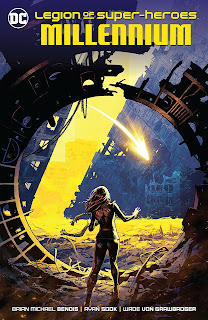
Review: Legion of Super-Heroes Vol. 1: Millennium trade paperback (DC Comics)

Legion of Super-Heroes Vol 1 Millennium

I like Brian Michael Bendis' writing, and I like the Legion of Super-Heroes, and having such a high-profile writer on an oft-ignored DC property seems to me a very good thing. But the first two-thirds of Legion of Super-Heroes Vol. 1: Millennium is a lot, a real sugar-rush of a start to this book that feels like it gets away from Bendis a little. It evens out eventually — aligned to when perspective character Superboy Jon Kent also stops to take a breath, so maybe some of this freneticism is intentional. To be sure, however, one is very ready for the 30-plus Legionnares to just stop talking for a second about the time that they do.

For all of that, there is not much happening in this first volume — there’s a villain, whom the Legion fights, and what would seem to be a major development regarding the planet Earth, though we’re not told much about what it all really means in specific (or emotional) terms. There’s some fine political wheeling and dealing as well, and the implication of trouble on the rise, but nothing in the way of a real cliffhanger, nothing to make you wonder on the edge of your seat what will happen next.

In a way that’s rather similar to Bendis' first volume of Young Justice, we get a lot of character interaction here but not as much in the way of overarching plot or setting up the status quo, and the biggest intimations about cosmic threats sound suspiciously like they’ll be resolved elsewhere. In other titles I might complain about the opposite — too much plot, not enough character development, but I rather wish Bendis would deliver both, especially when we’re dealing with teams like Young Justice and the Legion of Super-Heroes that’ve been out of the spotlight for so long.

[Review contains spoilers]

What I liked most about Millennium was Bendis' intriguing conception of the Legion. Their origin is not wholly different from Legion(s) classic — Cosmic Boy Rokk Krinn, Saturn Girl Imra Ardeen, and Lightning Lad Garth Ranzz save R.J. Brande from attack — but this time, Brande is the president of the United Planets who had recruited the kids for a youth committee, but was later inspired by the (alt-continuity, apparently apocryphal) examples of Grant Morrison’s JLA and the New Teen Titans to convert them into the Legion of Super-Heroes. In this way, the young Legion is semi-governmental — not beholden to the president, but not an independent organization created by a businessman either, which adds a new dynamic to their actions.

Second, similar to Mark Waid’s Legion (how’s that for a link to a review from 2006?!), the Legionnares are fans of the 21st century in ways both charming and silly. There is much here that’s futuristic, from the 3D tags that follow everyone around and identify them, to the next-level social media that records people’s in-the-moment emotions, to the apparent ease of time travel. At the same time, as Jon Kent notes, the Legionnares have a tendency to “pose” when they practice their superheroics, taking notes from their perception of the “old days,” and they have a litany of ideas about Jon’s life both correct and misunderstood. They’re daring and headstrong but also a little square, and that’s a fun and funny dynamic to read about.

As is perhaps not unusual for a Bendis comic, however, the first three issues of the main series are filled with talking, talking, talking (this after two issues of the rather muddled lead-in miniseries), often without any one character getting to finish a complete sentence. That’s not all bad when it’s Lois Lane and Clark Kent bantering on the couch; it becomes a virtual cacophony when there’s almost 30 characters in the scene. Letterer Dave Sharpe obviously has plenty heavy lifting to do here, but at times when three or more characters are talking in the same panel, I found myself having to trace back the word balloons to figure who was saying what. Usually I like comics by way of Aaron Sorkin, but Legion tested even my limits until Superboy finally sits down for his orientation and the Legion origin recap.

Millennium’s main story involves a tug-of-war over Aquaman’s trident, newly discovered in the future. We’re shown early on that “New Earth” does not have any oceans, the trident seems to be able to conjure water, and it’s not a hard bet that indeed, by the end of the story, the trident has been used to restore the oceans. But that act is a happy accident, and while the Legion seems very pleased about it, we’ve no sense of whose lives were made better by the oceans returning, what problem it solves for the people of Earth, and so on; it happens, and it’s said to be great, but in terms of what the audience feels emotionally, it doesn’t matter.

The closest to a traditional bad guy that the Legion fights here is Tortor, leader of the Horraz Collective, essentially a group of space pirates after the trident. Bendis introduces, but then almost immediately sidelines, longtime Legion foe Mordru, whom I thought was supposed to be a big deal, and I’m not sure if that’s a feint or if that’s a calculated shift on Bendis' part. Also making trouble is Crav, the General Nah of Rimbor (and Ultra Boy’s father), equally after the trident. The end of the book sees Nah threatening the Legion, but again, this seems awfully mild — we’ve no sense of the United Planets having a fragile peace or the like that might make Rimbor’s defection damaging.

Support Collected Editions -- Purchase Legion of Super-Heroes Vol. 1: Millennium

4.0

Rating

To that end, while I’m glad the team is back in Legion of Super-Heroes Vol. 1: Millennium, I wish there had been something altogether more gripping here for brand-new readers, especially, to hang their hats on. As in Young Justice, here there’s vague talk of big-C Crises that’re supposed to affect the Legion, but whether we’ll really see that here or if that’s a shill for Death Metal (or, now, Future State after that), I’m not sure. Unfortunately, those kinds of things tend to leave the individual series high and dry, especially with no big crossover event on the docket for Brian Michael Bendis himself any time soon. I enjoyed when Geoff Johns brought back the classic adult Legion for a period of time, picking up where the most familiar incarnations left off; I’m less enthused for a new Legion to do a rehash of “Great Darkness Saga” (a second rehash, even), though again, I’m happy to see Legion plus Bendis, if it sticks.

[Includes original and variant covers, character studies]

 
Design by Free WordPress Themes | Bloggerized by Lasantha - Premium Blogger Themes | Online Project management